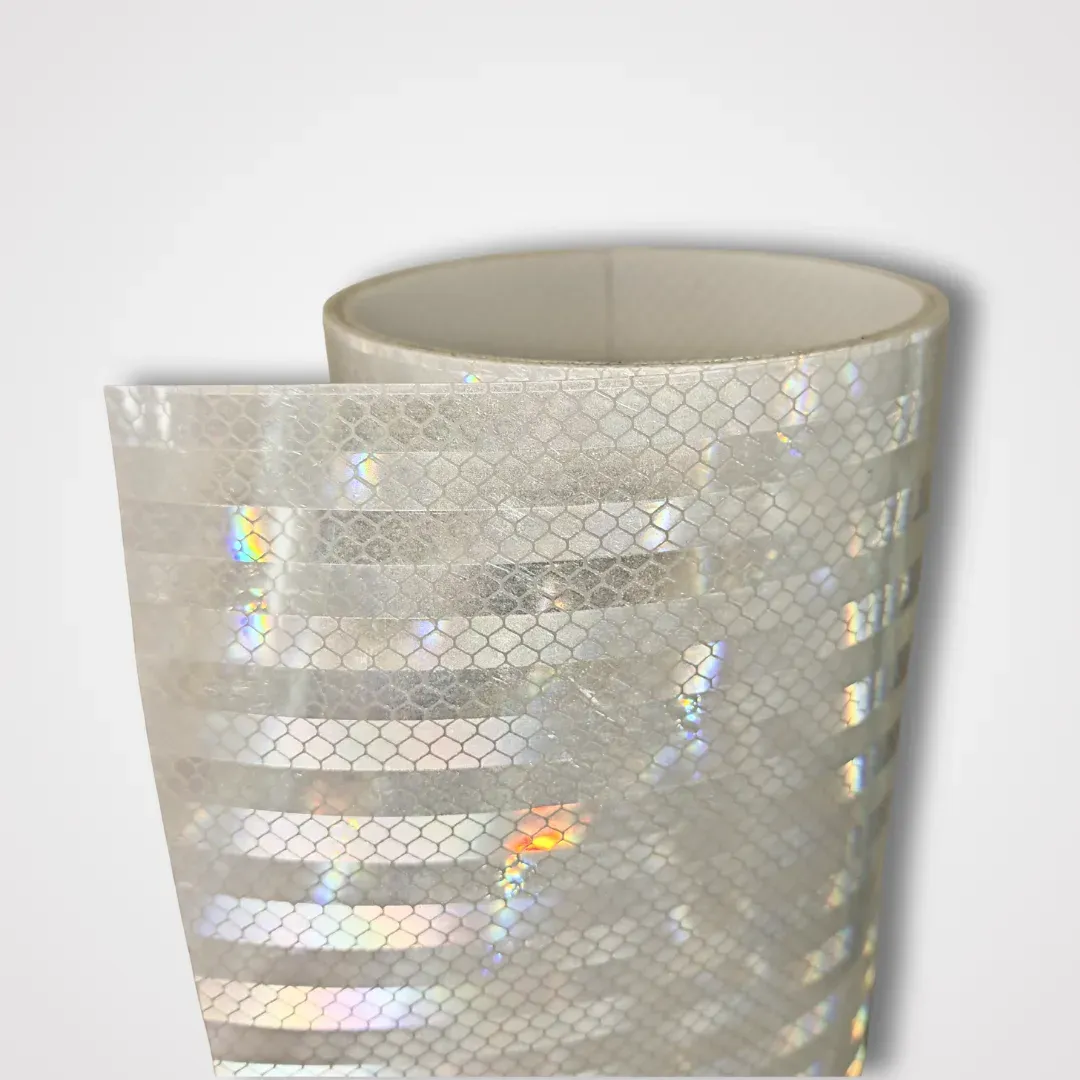
Traffic Reflective Film
Why Prismatic Structure Matters — Part 2: How to Select the Right Reflective Sheeting
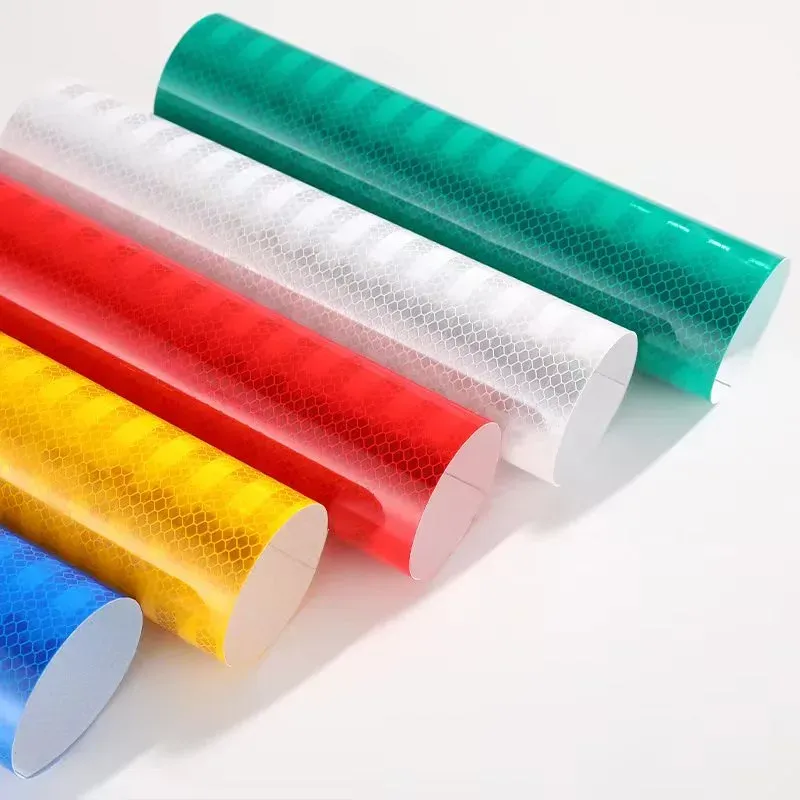
In Part 1, we explained how micro-prismatic structures work and why different reflective sheeting grades can perform very differently.
But understanding the grade alone is not enough.
For professional procurement, the real question is:
How will this reflective sheeting perform under the actual conditions of the project?
When evaluating micro-prismatic reflective sheeting, buyers should pay particular attention to six factors:
- Retroreflectivity
- Entrance angle
- Observation angle
- Outdoor durability
- Printing compatibility
- Adhesive performance
1. Retroreflectivity
Retroreflectivity describes how effectively the material returns light toward its source.
This is one of the most important technical indicators for traffic-sign materials.
However, one common purchasing mistake is comparing reflective films using only a single retroreflection value.
A supplier may quote one coefficient measured under one observation angle and one entrance angle.
That value is useful, but it does not describe the complete optical performance of the material.
Professional buyers should therefore request a retroreflectivity table covering several entrance-angle and observation-angle combinations.
This provides a much more realistic indication of how the reflective sheeting will perform in actual traffic environments.
2. Entrance Angle: Why Sign Position Matters
The entrance angle describes how incoming light strikes the reflective surface.
Imagine two identical traffic signs.
One is located directly ahead of the vehicle.
The other is positioned far to the side of the roadway.
Although both signs use the same reflective material, the headlights strike them at different angles.
The second sign therefore requires the reflective sheeting to maintain good performance at a larger entrance angle.
This is why entrance-angle performance becomes especially important for:
- Wide roads
- Curved roads
- Overhead signs
- Signs installed far from the traffic lane
- Large intersections
A reflective film that performs well at a small entrance angle may not perform equally well under more difficult geometries.
3. Observation Angle: Why Distance and Vehicle Geometry Matter
The driver's eyes and the vehicle headlights are not located in exactly the same position.
Because of this physical separation, a small observation angle is created between the light source and the observer.
As the vehicle approaches a sign, the viewing geometry changes.
This means that reflective sheeting must maintain suitable retroreflective performance across the relevant observation-angle range.
For professional projects, it is therefore not enough to ask whether the material "looks bright."
The material should be evaluated according to standardized optical testing conditions.
4. Outdoor Durability
Buyers frequently ask whether a reflective film is a:
5-year, 7-year, 10-year or 12-year material.
Service life is important, but these labels should not be interpreted without context.
Actual outdoor durability may be affected by:
- UV exposure
- High temperature
- Low temperature
- Humidity
- Rain
- Dust
- Pollution
- Installation method
- Surface preparation
- Orientation of the sign
- Cleaning and maintenance
For example, reflective sheeting installed in a mild climate may experience very different aging conditions from the same material installed in a hot, humid or high-UV region.
Professional buyers should therefore evaluate both the manufacturer's durability specification and the actual installation environment.
5. Printing Compatibility
Reflective sheeting is usually only one component of the finished traffic sign.
Depending on the production process, the material may need to support:
- Screen printing
- Digital printing
- UV printing
- Solvent or eco-solvent printing
- Cut graphics
- Transparent overlays
- Protective laminates
A reflective film may have excellent optical performance but still create production problems if it is incompatible with the intended printing method.
Before placing an order, buyers should clearly inform the supplier how the material will be processed.
6. Adhesive Performance
The optical surface often receives the most attention, but the adhesive system is also critical.
Reflective sheeting is commonly laminated onto aluminum or other rigid substrates.
Poor adhesive performance can cause:
- Edge lifting
- Bubbling
- Delamination
- Poor bonding
- Premature installation failure
Professional buyers should therefore confirm:
- Recommended substrate
- Application temperature
- Surface preparation requirements
- Adhesive type
- Long-term bonding performance
Good retroreflection cannot compensate for poor installation performance.
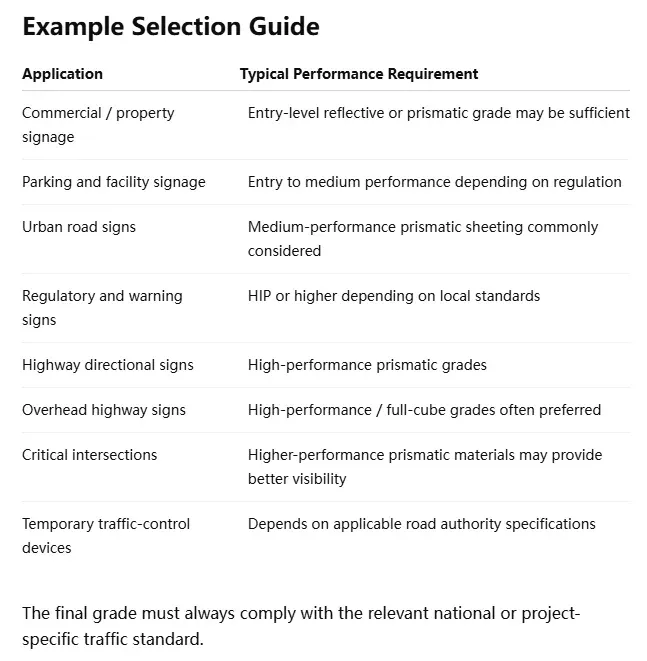
How Should You Select the Right Grade?
There is no single reflective sheeting grade that is ideal for every project.
For a commercial identification sign, premium highway-grade reflective sheeting may add unnecessary cost.
For a high-speed highway sign, however, selecting a low-performance material simply because it is cheaper may compromise nighttime visibility.
A more professional selection process is:
Application → Required Standard → Viewing Geometry → Required Retroreflectivity → Durability → Printing Process → Adhesive System → Cost
Rather than: Price → Brightness → Purchase
This difference is especially important for professional road-sign manufacturers, contractors, distributors and project suppliers.
A Better Way to Purchase Reflective Sheeting
Instead of asking a supplier only:
"What grade is this reflective film?"
professional buyers should ask:
"Which standard and type does the material meet, under what observation and entrance angles is the retroreflectivity measured, what is the intended application, and can you provide the technical data sheet?"
These questions make product comparison much more meaningful.
At Anshi, we work with professional buyers to match reflective materials with their actual applications, including road traffic signs, safety markings, public-facility signs and related reflective solutions.
Selecting reflective sheeting should not simply be about choosing the brightest material.
It should be about selecting the right optical performance for the right application.
Anshi — Reflective Materials & Traffic Safety Solutions